
Year
2025
Principal Investigator
Platform 1
Platform 2
Location
Italy, IT
Abstract
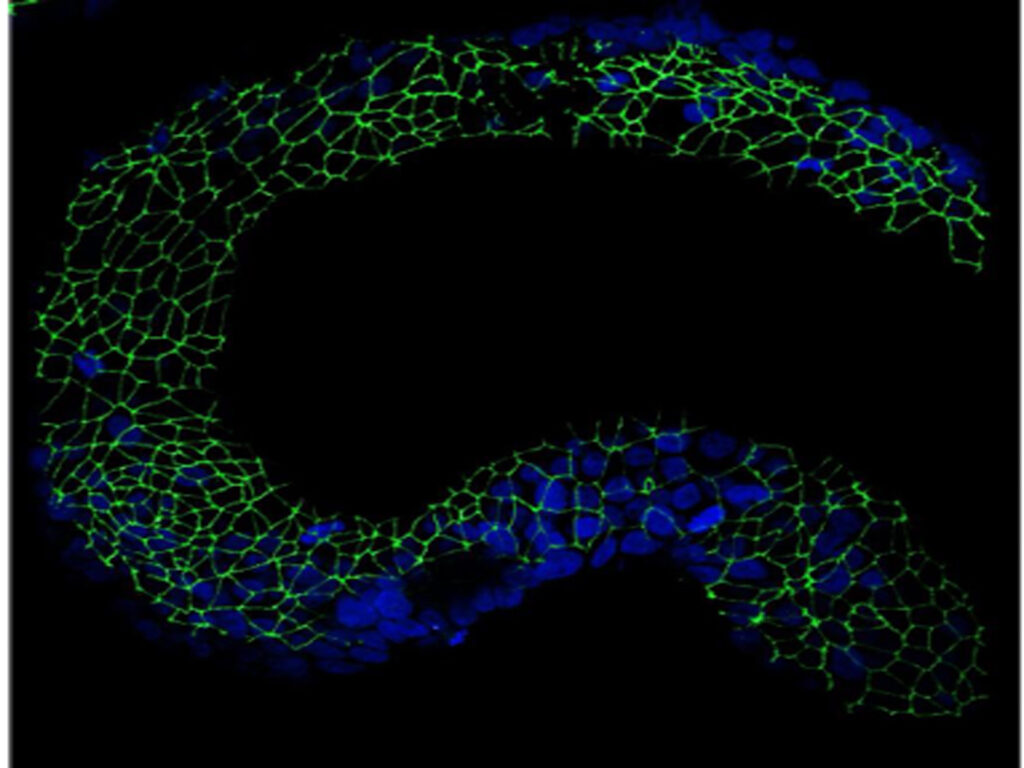
The project aims to establish a model of the intestine barrier based on human induced pluripotent stem cells (hiPSCs), using a temporal series of growth factors mimicking embryogenic intestinal development. As iPSCs can be efficiently directed to differentiate into human intestinal organoids, acquiring both absorptive and secretory functions, the model will be used to investigate the epithelial barrier function following a number of insults, including metabolic dysregulation, oxidative stress, micro- and nanoplastics, persistent chemicals. With an eye on upscaling, microfabrication approaches (e.g., microwell arrays) will be sought to augment reproducibility of organoid formation. A set of readout protocols, largely relying on high-content microscopy and AI-based segmentation and feature extraction methodologies will be optimized, to develop a phenotypic drug screening platform for the identification of novel therapeutic strategies.
Objectives
- Objective 1 - Establishment of a robust and scalable in vitro model of the intestine barrier and induction of a diseased condition
- Objective 2 – Establishment of a phenotypic screening protocols based on high-content microscopy and AI-based feature extraction for the validation of therapeutic approaches.
Collaborators
- Alberto Rainer (Università Campus Bio-Medico di Roma)
- Ermanno Cordelli (Università del Salento)
- Enrico Lemma (università Campus Bio-Medico di Roma)
- Alessia Cedola (CNR-NANOTEC)
- Egeria Scoditti (CNR-IFC)
- Amalia Gastaldelli (CNR-IFC)
Key 5 publications
- 1. E. Mello, S. Sorrentino, A. Bucciarelli, E. De Luca, H. Nyggard , S. Wendt, A. Rainer, G. Gigli, L. Moroni, A. Polini, P. Mozetic. Geometrical constraints dictate assembly and phenotype of human iPSC-derived motoneuronal spheroids. Stem Cell research and Therapy (2025) 16; 417. DOI: 10.1186/s13287-025-04547-4
- 2. M. Gori, A. Altomare, S. Cocca, E. Solida, M. Ribolsi, S. Carotti, A. Rainer, M. Francesconi, S. Morini, M. Cicala, M.P.L. Guarino, Palmitic acid affects intestinal epithelial barrier integrity and permeability in vitro, Antioxidants 9 (2020) 417. doi:10.3390/antiox9050417
- 3. C. Coricciati, E. Mello, E. De Luca, G. Gigli, A. Rainer, P. Mozetic. Gut-on-chip and Liver-on-chip platforms for modeling human pathophysiology. Current Opinion in Biomedical Engineering (2025) 35; 100601. DOI: 10.1016/j.cobme.2025.100601
- 4. M. Gori, S.M. Giannitelli, M. Torre, P. Mozetic, F. Abbruzzese, M. Trombetta, E. Traversa, L. Moroni, A. Rainer. Biofabrication of hepatic constructs by 3D bioprinting of a cell-laden thermogel: an effective tool to assess drug-induced hepatotoxic response. Adv Healthcare Mater 9(21) (2020) 2001163. doi: 10.1002/adhm.202001163.
- 5. M. Gori, S.M. Giannitelli, A. Zancla, P. Mozetic, M. Trombetta, A. Rainer. Quercetin and hydroxytyrosol as modulators of hepatic steatosis: A NAFLD‐on‐a‐chip study. Biotechnology and Bioengineering. 118 (2021) 142-152. doi: 10.1002/bit.27557.
People
- Pamela Mozetic (CNR-NANOTEC)
- Eleonora Mello (Università del Salento, Associata CNR-NANOTEC)
