
Abstract
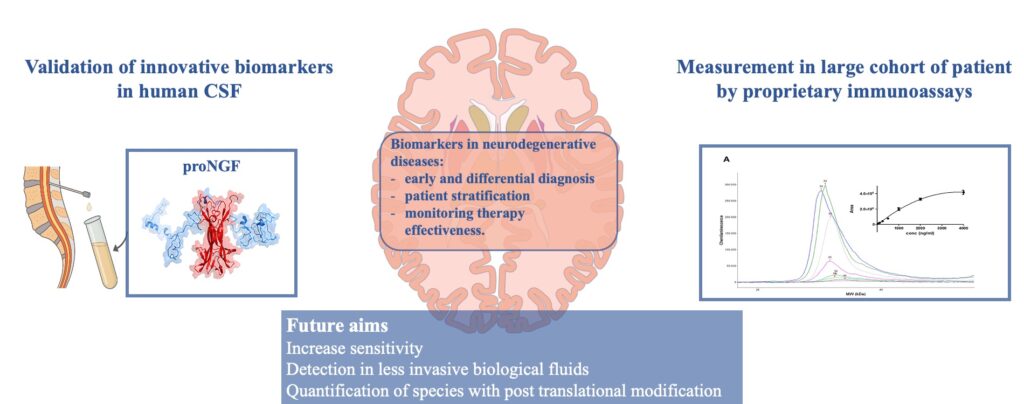
Biomarkers play a crucial role in the diagnosis and monitoring of diseases, enabling early and differential diagnosis, patient stratification, and assessment of therapy effectiveness in clinical practice. In neurodegenerative diseases, the discovery of new biomarkers is urgently needed to advance personalized medicine—where therapies are already available—or to optimize therapeutic monitoring in clinical trials. This project aims to validate a new promising biomarker for Alzheimer’s and other neurodegenerative diseases, such as proNGF, the precursor of NGF. A specific immunoassay has already been developed by our team. In particular, proNGF has been quantified in large cohorts of cerebrospinal fluid samples from patients across diagnostic groups using our patented assay, showing statistically significant differences and, importantly, improved diagnostic accuracy. Our objectives are to: i) validate this biomarker in larger patient cohorts; ii) improve assay sensitivity, including through the use of nanotechnologies, to enable detection in less invasive biological fluids; and iii) investigate post-translational modifications of proNGF, such as glycosylation, which might be used as additional biomarkers. This project has a clear translational focus while also contributing to the understanding of disease mechanisms and advancing basic research.
Objectives
- Objective 1 - Validating proNGF as biomarker for Alzheimer’s and other neurodegenerative diseases in large patient cohorts, using our specific immunoassay and comparing levels across diagnostic groups
- Objective 2 – Improving the sensitivity of our immunoassay, including through nanotechnology-based approaches, to enable reliable detection of the biomarker in less invasive biological fluids such as serum, plasma, or urine
- Objective 3 – Investigating post-translational modifications of proNGF, such as glycosylation, and assessing their potential as additional biomarkers by quantifying these modified species across diagnostic groups
Collaborators
- Rita Florio (EBRI);
- Antonio Galeone (CNR Nanotec);
- Elisabetta Primiceri (CNR Nanotec);
- Riccardo Rizzo (CNR Nanotec);
- Chiara Zecca (UniBA/card. Panico);
- Antonino Cattaneo (EBRI);
- Giuseppe Gigli (Unisalento);
- Giancarlo Logroscino (UniBA).
- Alessia Cedola (CNR Nanotec)
Key 5 publications
- 1. Cerebrospinal fluid level of proNGF as potential diagnostic biomarker in patients with frontotemporal dementia. Malerba F, Florio R, Arisi I, Zecca C, Dell'Abate MT, Logroscino G, Cattaneo A. Front Aging Neurosci. 2024 Jan 25;15:1298307. doi: 10.3389/fnagi.2023.129830
- 2. Selection and characterization of human scFvs targeting the SARS-CoV-2 nucleocapsid protein isolated from antibody libraries of COVID-19 patients. Lisi S, Malerba F, Quaranta P, Florio R, Vitaloni O, Monaca E, Bruni Ercole B, Bitonti AR, Del Perugia O, Mignanelli M, Perrera P, Sabbatella R, Raimondi F, Piazza CR, Moles A, Alfano C, Pistello M, Cattaneo A. Sci Rep. 2024 Jul 9;14(1):15864. doi: 10.1038/s41598-024-66558-0.
- 3. proNGF Measurement in Cerebrospinal Fluid Samples of a Large Cohort of Living Patients With Alzheimer's Disease by a New Automated Immunoassay. Malerba F, Arisi I, Florio R, Zecca C, Dell'Abate MT, Bruni Ercole B, Camerini S, Casella M, Logroscino G, Cattaneo A. Front Aging Neurosci. 2021 Oct 27;13:741414. doi: 10.3389/fnagi.2021.741414.
- 4. A Quantitative Bioassay to Determine the Inhibitory Potency of NGF-TrkA Antagonists. Malerba F, Bruni Ercole B, Florio R, Cattaneo A. SLAS Discov. 2021 Jul;26(6):823-830. doi: 10.1177/24725552211000672. Epub 2021 Apr 19.
- 5. Cladribine and ocrelizumab induce differential miRNA profiles in peripheral blood mononucleated cells from relapsing-remitting multiple sclerosis patients. Arisi I, Malimpensa L, Manzini V, Brandi R, Gosetti di Sturmeck T, D'Amelio C, Crisafulli S, Ferrazzano G, Belvisi D, Malerba F, Florio R, Pascale E, Soreq H, Salvetti M, Cattaneo A, D'Onofrio M, Conte A. Front Immunol. 2023 Dec 13;14:1234869. doi: 10.3389/fimmu.2023.1234869.
People
- Clarissa Loiola.
