
Abstract
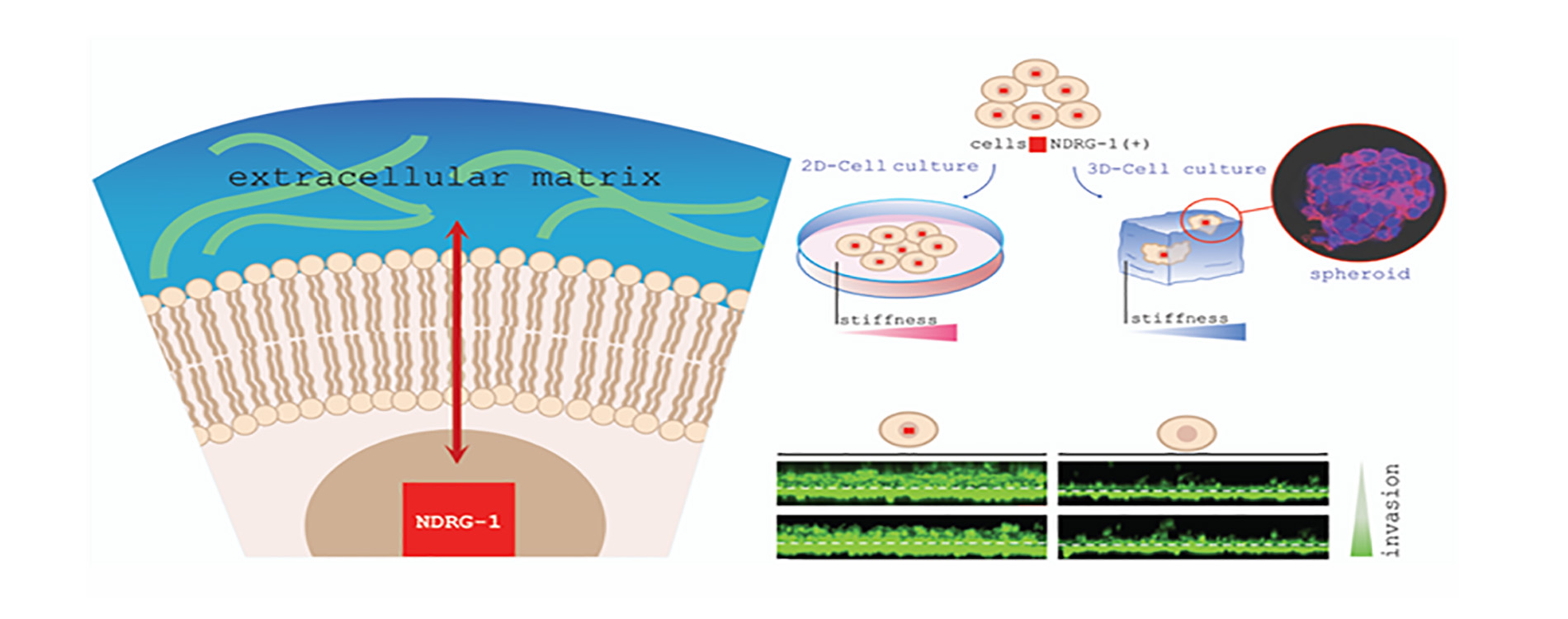
Breast carcinoma (BC) is one of the leading causes of female mortality worldwide. Triple-negative breast carcinoma (TNBC) is a subgroup and represents one of the most aggressive and difficult-to- treat forms of breast cancer characterized by a high adaptive capacity of tumor cells to the surrounding mechanical environment. The translation of microenvironmental stimuli into changes in cellular function is dependent on the presence of a molecular machinery capable of sensing and responding to these forces. Once received, the signal is amplified and propagated through several intracellular mediators. Among these, NDRG1 represents a signal node from many membrane receptors1. Through a multidisciplinary approach that combines the development of biomaterials, cellular biology, and correlative microscopy, this project aims to study the molecular mechanisms regulating BC/TNBC cell progression in response to changes in extracellular mechanical forces, focusing on the role of the NDRG-1 factor in the mechanisms that regulate the migration and invasiveness.]
Objectives
- Objective 1 - [Molecular mechanisms of NDRG1 mediated breast cancer motility/invasion]
- Objective 2 – [Control of cellular responses to mechanotransduction through NDRG1]
- Objective 3 - [Analysis of migratory activity in 3D dynamic conditions, elucidating the effects of potential environmental stimuli (e.g., drugs)]
Collaborators
- Prof. Daniele Vergara -Dipartimento di Scienze e Tecnologie Biologiche ed Ambientali-Unisalento,
- Istituto Tumori “Giovanni Paolo II” Bari
- European Institute of Oncology (IEO), Milan.
Key 5 publications
- 1. Saponaro, C., Damato, M., Stanca, E. et al. Unraveling the protein kinase C/NDRG1 signaling network in breast cancer. Cell Biosci (2024), Doi.org/10.1186/s13578-024-01336-z
- 2. Quarta A., Gallo N., Vergara D., Salvatore L., Nobile C., Ragusa A., Gaballo A. Investigation on the Composition of Agarose-Collagen I Blended Hydrogels as Matrices for the Growth of Spheroids from Breast Cancer Cell Lines. Pharmaceutics (2021), Doi:10.3390/pharmaceutics13070963
- 3. Morello G, Quarta A, Gaballo A, Moroni L, Gigli G, Polini A, Gervaso F. A thermosensitive chitosan/pectin hydrogel for long-term tumor spheroid culture. Carbohydrate Polymers (2021), Doi: 10.1016/j.carbpol.2021.118633.
- 4. Bianco M, Zizzari A, Priore P, Moroni L, Metrangolo P, Frigione M, Rella R, Gaballo A, Arima V. Lab-on-a-brane for spheroid formation. Biofabrication (2019), Doi: 10.1088/1758- 5090/ab0813
- 5. Vergara, D., Bianco, M., Pagano, R., Priore, P., Lunetti, P., Guerra, F., Bettini, S., Carallo, S.,Zizzari, A., Pitotti, E., Giotta, L., Capobianco, L., Bucci, C., Valli, L., Maffia, M., Arima, V., Gaballo, A. An SPR based immunoassay for the sensitive detection of the soluble epithelial marker E-cadherin Nanomedicine: Nanotechnology, Biology, and Medicine (2018), Doi: 10.1016/j.nano.2018.05.018.
People
- Daniele Vergara
- Francesca Gervaso
- Alessandro Polini
