
Abstract
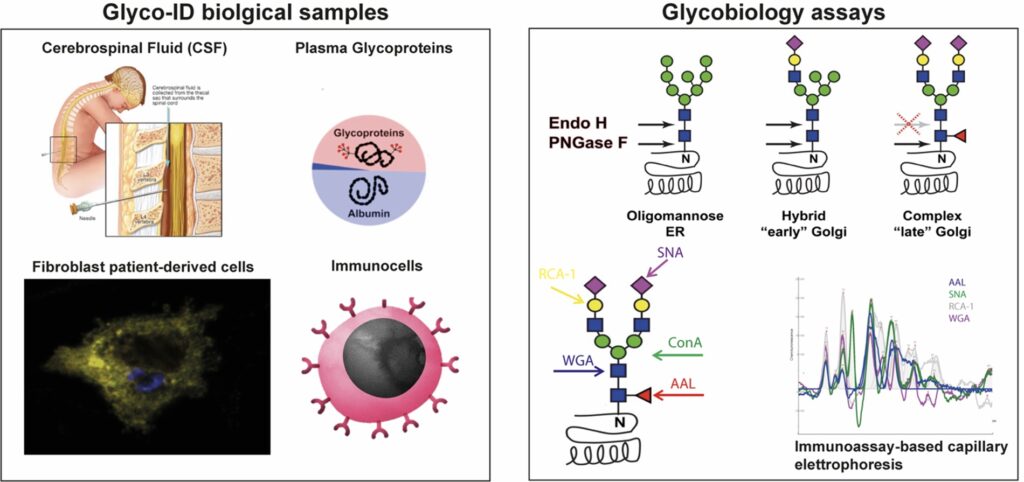
One-third of the human-secreted proteome undergoes glycosylation, a post-translational modification that attaches carbohydrates to proteins (glycoproteins). Emerging findings showed that glycosylation is a molecular high-complex language enough to barcode a protein (Glyco-ID) and drive protein stability, cellular trafficking, and cell-surface interactions. Disease-associated deregulation of glycosylation can be directly dependent on genetic defects but also associated with metabolism, aging, and cancer. However, little is known about how the Glyco-ID of pathogenic biomarkers or cellular checkpoints could be used as a diagnostic and/or therapeutic target. This proposal aims 1) to identify aberrant Glyco-ID of biomarkers in patient-centered metabolic and neurodegenerative diseases; and 2) to understand the Glyco-ID of key immune cell checkpoints and its role in tumor immune evasion, in CAR-T therapy perspective. In this context, we have developed new approaches to studying protein-carbohydrate interactions using biochemical and glycobiology assays coupled with automated capillary-based immunoassays.
Objectives
- Objective 1 - Characterize the Glyco-ID of disease-associated biological samples: To identify proteins that are differently glycosylated in disease-associated biological fluids or cells, we will use cutting-edge glycobiology techniques coupled with automated capillary-based immunoassays.
- Objective 2 – Determine the glycosylation signature of specific targets that can be used as biomarkers of diseases: Identify pathogenic biomarkers by purification through immunoprecipitation (IP) lectin-based affinity. The degree of glycosylation in patient samples and healthy controls will be scored and computed to study the correlation between clinical features and Glyco-ID.
- Objective 3 – Develop cellular models for studying the cause-effect relationship between glycosylation and cellular etiology in diseases: Study the pathogenic Glyco-ID of diseases by structural- functional correlation of glycosylation and cell model phenotypes to identify potential therapeutic avenues
Collaborators
- Prof. Giancarlo Logroscino, Professore Ordinario di Neurologia presso l’Università degli Studi di Bari “Aldo Moro” (UNIBA) e direttore del Centro di Malattie Neurodegenerative e invecchiamento cerebrale, Dipartimento di Ricerca Clinica in Neurologia della UNIBA presso Fondazione Card. G. Panico di Tricase.
- Dr. Francesca Malerba, Head of the Facility "NGF LAB" Fondazione EBRI - Rita Levi- Montalcini
- Prof. Hamed Jafar-Nejad, Department of Molecular & Human Genetics Baylor College of Medicine
- Prof. Hudson Freeze, Professor of Glycobiology and Director of the Human Genetics Program and Sanford Children’s Health Research Center at Sanford Burnham Prebys Medical Discovery Institute (SBP) in La Jolla, CA, USA
- Dr. Tadashi Suzuki, Team Leader, Glycometabolome Team, Systems Glycobiology Research Group, RIKEN
- Ilaria Palamà and Gabriele Maiorano, CNR Nanotec, Lecce
- Sarah Tettamenti, Tettamanti Research Center, Department of Pediatrics, University of Milano-Bicocca/Fondazione MBBM, Monza, Italy
Key 5 publications
- 1. Pandey, A., Galeone, A., Han, S.Y., Story, B.A., Consonni, G., Mueller, W.F., Steinmetz, L.M., Vaccari, T., Jafar-Nejad, H. Gut barrier defects, intestinal immune hyperactivation and enhanced lipid catabolism drive lethality in NGLY1-deficient Drosophila. Nat Commun 14, 5667 (2023).
- 2. Galeone, A., Adams, J.M., Matsuda S., Presa, M.F., Pandey, A., Han, S.Y., Tachida, Y., Hirayama, H., Vaccari, T., Suzuki, T., Lutz, C.M., Affolter, M., Zuberi, A., Jafar-Nejad, H. Regulation of BMP4/Dpp retrotranslocation and signaling by deglycosylation. eLife 9:e55596 (2020).
- 3. Han, S.Y., Pandey, A., Moore, T., Galeone, A., Duraine, L., Jafar-Nejad, H. A conserved role for AMP-activated protein kinase in NGLY1 deficiency. PLOS Genetics 16(12): e1009258. (2020)
- 4. Galeone A., Han, S.Y., Huang C., Hosomi A., Suzuki, T., Jafar-Nejad, H. Tissue-specific regulation of BMP signaling by Drosophila N-glycanase 1. eLife 6:e27612 (2017).
- 5. Viti, F., De Giorgio, R., Ceccherini, I. Galeone, A, et al. Multi-disciplinary Insights from the First European Forum on Visceral Myopathy 2022 Meeting. Dig Dis Sci 68, 3857–3871 (2023).
People
- Elisabetta Cuna
- Andrea Lia
- Bruna My
- Ludovica Rizzo
