
Abstract
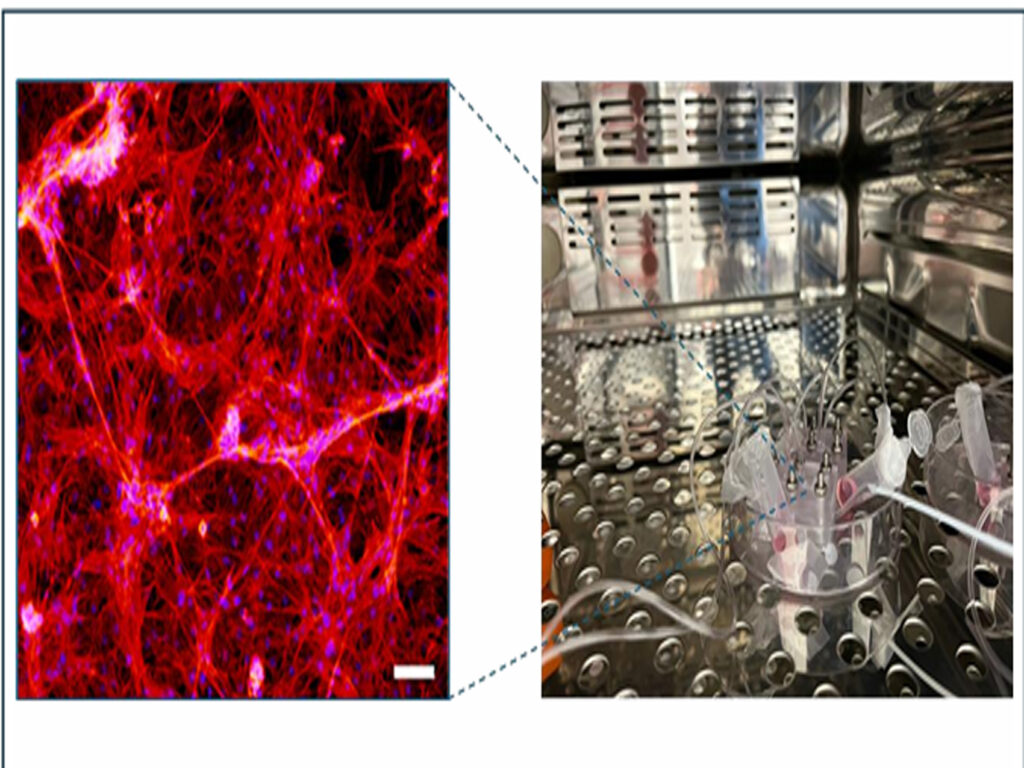
Microphysiological systems (MPSs) replicate essential biological processes and cellular responses in vitro, mirroring the in vivo behavior of cells, tissues, and organs. Within the body, cells experience biomechanical stimuli that vary depending on the type of tissue and may change in response to disease or injury. Biomechanical forces, such as shear stress, compression, and cyclic stretching, play a crucial role in regulating cell behavior, potentially enhancing, negating, or even reversing responses to biochemical signals or drug candidates. Replicating such stresses is essential for accurately modeling in vivo behavior in these systems. In MISS, we will focus on the effects of mechanical loading in MPSs resembling the synovium, the key actor in an important autoimmune disease, i.e. rheumatoid arthritis (RA). Starting from patient-derived cells, the role of mechanical stresses in the progression of the molecular processes in RA will be elucidated.
Objectives
- Objective 1 - Developing microfabrication technologies for successfully integrating mechanical capabilities in MPSs
- Objective 2 – Study of cell behavior in a synovium MPS upon application of physiological mechanical stress
- Objective 3 – Definition of any correlation between mechanical loading and drug response in a RA synovium MPS
Collaborators
Key 5 publications
- 1. A Bucciarelli, N Selicato, C Coricciati, A Rainer, AL Capodilupo, G Gigli, L Moroni, A Polini*, F Gervaso*, Modelling methacrylated chitosan hydrogel properties through an experimental design approach: from composition to material properties”, Journal of Materials Chemistry B, 12, 2024. Selected for Front cover J. Mater. Chem. B, 2024,12, 10113-10114.
- 2. F Bisconti, B Vilardo, G Corallo, F Scalera, G Gigli, A Chiocchetti, A Polini*, F Gervaso*, “An Assist for Arthritis Studies: A 3D Cell Culture of Human Fibroblast-Like Synoviocytes by Encapsulation in a Chitosan-Based Hydrogel”, Advanced Therapeutics, 2024, 2400166. Selected for Front cover for Advanced Therapeutics: Volume 7, Issue 12, 2470027.
- 3. A Bucciarelli, X Paolelli, E De Vitis, N Selicato, F Gervaso*, G Gigli, L Moroni, A Polini*, “VAT photopolymerization 3D printing optimization of high aspect ratio structures for additive manufacturing of chips towards biomedical applications”, Additive Manufacturing, 60, 103200, 2022.
- 4. A Polini*, LL del Mercato, A Barra, YS Zhang, F Calabi, G Gigli, “Towards the development of human immune-system-on-a-chip platforms”, Drug Discovery Today, 24, 517, 2019.
- 5. YS Zhang, J Aleman, SR Shin, T Kilic, D Kim, SA Mousavi Shaegh, S Massa, R Riahi, S Chae, N Hu, H Avci, W Zhang, A Silvestri, A Sanati Nezhad, A Manbohi, F de Ferrari, A Polini, G Calzone, N Shaik, P Alerasool, E Budina, J Kang, N Bhise, J Ribas, A Pourmand, A Skardal, T Shupe, CE Bishop, MR Dokmeci A Atala, A Khademhosseini, “Multisensor-integrated organs- on-chips platform for automated and continual in situ monitoring of organoid behaviors”, Proceedings of the National Academy of Sciences of the United States of America, 114, E229346T, 2017
People
- Francesco Bisconti
- Noemi Corbezzolo
- Alessandro De Giorgi
- Francesca Gervaso
- Giuseppe Gigli
