
Abstract
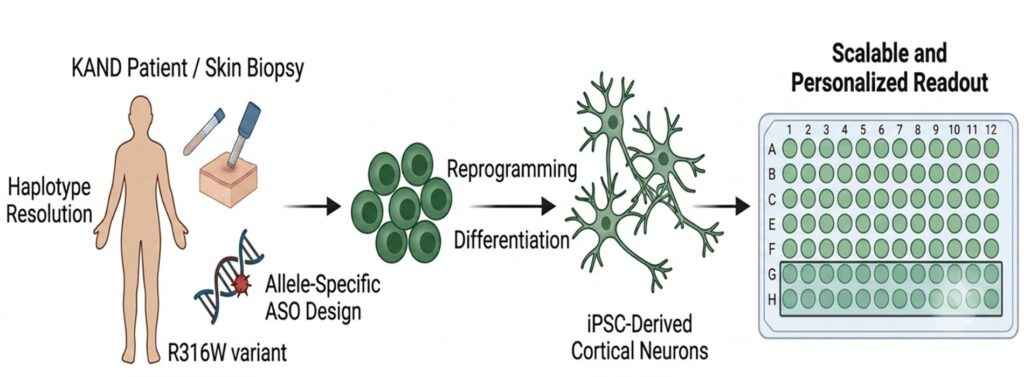
KIF1A-associated neurological disorder (KAND) is an extremely rare neurodegenerative condition, frequently resulting in severe outcomes, characterized by a diverse range of symptoms linked to predominantly heterozygous de novo missense mutations in the KIF1A gene. The phenotypic characteristics encompass brain and optic nerve atrophy, resistant epilepsy, cognitive deficits, spasticity, and neuropathy. Antisense oligonucleotide therapies offer a hopeful avenue for personalized treatment options in such ultrarare diseases. KIF1A is a neuron-specific member of the kinesin-3 family and acts as a motor protein involved in the anterograde transport of cargo along axonal microtubules. Multiple de novo mutations have been identified in the KIF1A motor domain, resulting in a loss of motility or functionality of the motor protein. Here, we will study the de novo pathogenic c.946C>T variant in KIF1A (p. R316W), which was shown to act as a dominant negative variant and used in this study as a prototype for ASO/s (antisense aligonucleotide/s) development and personalised treatment
Objectives
- Objective 1 - Antisense Oligonucleotides design
- Objective 2 – In-vitro validation of ASOs in hTERT-immortalized fibroblast Bj-5ta
- Objective 3 – In-vitro validation of ASOs in patient-derived-induced Pluripotent Stem Cells (iPSCs)
Collaborators
- KIF1A Italia (https://kif1a.it/)
- The Telethon Institute of Genetics and Medicine (TIGEM), Napoli, Italy
- Antonino Cattaneo European Brain Research Institute (EBRI), Roma, Italy
- Francesca Malerba European Brain Research Institute (EBRI), Roma, Italy
- Serena Lattante, Dipartimento di Medicina Sperimentale, Lecce, Italy
- Dott.ssa Maria Accadia, Servizio di Genetica Medica, A.O. Card. G. Panico (Tricase)
Key 5 publications
- 1. Rizzo R, Russo D, Kurokawa K, Sahu P, Lombardi B, Supino D, Zhukovsky MA, Vocat A, Pothukuchi P, Kunnathully V, Capolupo L, Boncompain G, Vitagliano C, Zito Marino F, Aquino G, Montariello D, Henklein P, Mandrich L, Botti G, Clausen H, Mandel U, Yamaji T, Hanada K, Budillon A, Perez F, Parashuraman S, Hannun YA, Nakano A, Corda D, D’Angelo G and Alberto Luini (2021). Golgi maturation‐dependent glycoenzyme recycling controls glycosphingolipid biosynthesis and cell growth via GOLPH3. EMBO JOURNAL, ISSN: 1460-2075, doi: DOI: 10.15252/embj.2020107238.
- 2. Subramanian A, Capalbo A, Ravi Iyengar N, Rizzo R, Di Campli A, Di Martino R, Lo Monte M, Beccari AR, Yerudkar A, Del Vecchio C, Glielmo L, Turacchio G, Pirozzi M, Geon Kim S, Henklein P, Cancino J, Parashuraman S, Diviani D, Fanelli F, Sallese M, Luini A (2019). Auto-regulation of Secretory Flux by Sensing and Responding to the Folded Cargo Protein Load in the Endoplasmic Reticulum. CELL, ISSN: 1097-4172, doi: 10.1016/j.cell.2019.01.035
- 3. Pothukuchi P, Agliarulo I, Russo D, Rizzo R, Russo F, Parashuraman S (2019). Translation of genome to glycome: role of the Golgi apparatus. FEBS LETTERS, ISSN: 0014-5793, doi: 10.1002/1873-3468.1354.
- 4. Lania G, Nanayakkara M, Maglio M, Auricchio R, Porpora M, Conte M, De Matteis MA, Rizzo R, Luini A, Discepolo V, Troncone R, Auricchio S, Barone MV (2019). Constitutive alterations in vesicular trafficking increase the sensitivity of cells from celiac disease patients to gliadin. COMMUNICATIONS BIOLOGY, ISSN: 2399-3642, doi: 10.1038/s42003-019-0443-1.
- 5. Russo D, Della Ragione F, Rizzo R, Sugiyama E, Scalabrì F, Hori K, Capasso S, Sticco L, Fioriniello S, De Gregorio R, Granata I, R Guarracino M, Maglione V, Johannes L, Bellenchi GC, Hoshino M, Setou M, D'Esposito M, Luini A, D'Angelo G (2017). Glycosphingolipid metabolic reprogramming drives neural differentiation. EMBO JOURNAL, ISSN: 1460-2075, doi: 10.15252/embj.201797674
People
- Riccardo Rizzo
- Gabriella De Blasi
- Gianuca Malfitano
