
Year
2025
Principal Investigator
Platform
Location
Italy, IT
Abstract
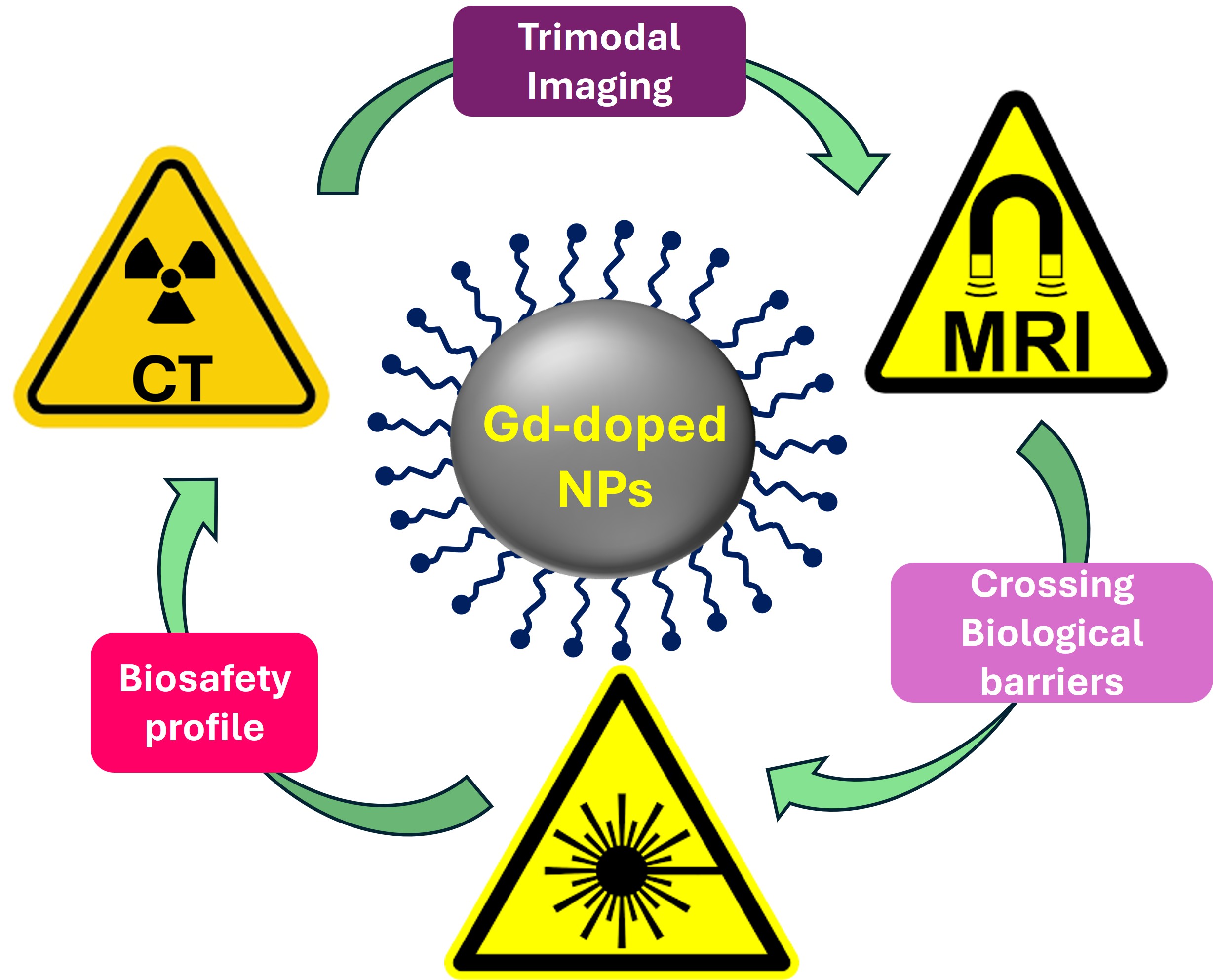
Upon FDA approval of gadolinium-based contrast agents for MRI, Gd-chelates have been widely utilized to enhance imaging quality, especially in the brain. Thanks to its large absorption coefficient Gd is also suitable for Computed Tomography, but recently severe concerns about stability and safety upon injection have been raised. Nevertheless, in the last years inorganic nanomaterials have gained prominence in medical imaging due to their customizable compositional and physicochemical properties, enabling detailed visualization of structures and processes at multiple levels. Gd-doped nanoparticles may serve as powerful tools for trimodal imaging by both CT, MRI and fluorescence imaging. The proposal aims to develop Gd-doped ZnO nanoparticles for diagnosing brain cancer through trimodal imaging and is intended as a multidisciplinary platform that includes complementary competences and combines multiple microscopy techniques. The project outline is organized in 3 Work Packages, 5 main Objectives, 7 Deliverables and 5 Milestones in a time frame of 24 months.
Objectives
- Objective 1 - Synthesis of the nanoparticles by chemical approach: attention will be given to control the size of the nanoparticles that should be kept below 10 nm to enable the transport through biological barriers.
- Objective 2 – Surface functionalization of the Gd-doped nanoparticles: the establishment of robust coatings is a fundamental requisite to afford stability of the particles, to preserve inherent properties of the material and to enhance biocompatibility.
- Objective 3 – Characterization of Gd-doped nanoparticles: this task is crucial to assess the properties of the prepared materials and involves multidisciplinary competences and skills for each of the techniques to be used.
- Objective 4 – Cellular studies: they include the characterization of the biological fingerprint of the nanoparticles and the evaluation of the transport capability through biological barriers by setting a simplified model of BBB.
- Objective 5 – Investigation of the trimodal imaging potential of the nanoparticles. The measures will be performed from gel phantoms containing the nanoparticles to 3D brain cancer models, for each of the imaging techniques.
Collaborators
- Dott. Riccardo Di Corato, CNR Institute for Microelectronics and Microsystems
- Dott. Franco De Nuccio, University of Salento
Key 5 publications
- 1. Yanlan Liu; Kelong Ai; Qinghai Yuan; Lehui Lu. Fluorescence-enhanced gadolinium-doped zinc oxide quantum dots for magnetic resonance and fluorescence imaging. Biomaterials. 2011; 32(4), 1185–1192.
- 2. Fatima A, Ahmad MW, Al Saidi AKA, Choudhury A, Chang Y, Lee GH. Recent Advances in Gadolinium Based Contrast Agents for Bioimaging Applications. Nanomaterials. 2021; 11(9):2449.
- 3. Molaei MJ. Gadolinium-doped fluorescent carbon quantum dots as MRI contrast agents and fluorescent probes. Sci Rep. 2022; 12(1):17681.
- 4. Quarta A., Piccirillo C., Mandriota G., Di Corato R. Nanoheterostructures (NHS) and Their Applications in Nanomedicine: Focusing on In Vivo Studies. Materials, 2019; 12(1):139.
- 5. Pérez-López A, Torres-Suárez AI, Martín-Sabroso C, Aparicio-Blanco J. An overview of in vitro 3D models of the blood- brain barrier as a tool to predict the in vivo permeability of nanomedicines. Advanced Drug Delivery Reviews. 2023; Volume 196, 114816, ISSN 0169-409X
People
- Alessia Nito
- Annalisa Caputo
- Concetta Nobile
- Massimo Cuscunà
- Luigi Carbone
- Daniela Simeone
- Riccardo Di Corato
- Ross Rinaldi
- Francesca Palermo
- Lorenzo Massimi
- Alessia Cedola
- Giuseppe Gigli
