
Abstract
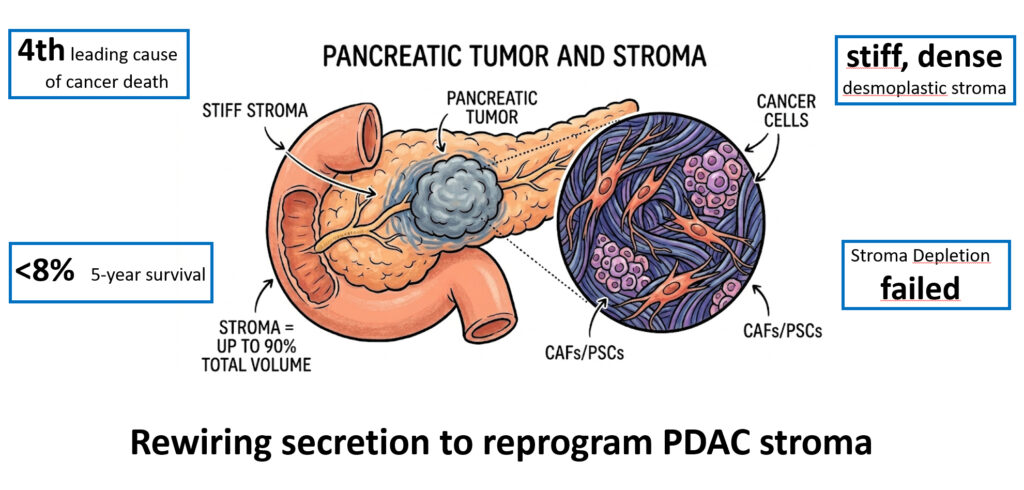
The STORM project aims to investigate the role of the cell secretory pathway in modulating the tumor microenvironment (TME) in pancreatic ductal adenocarcinoma (PDAC). The hypothesis is that extracellular matrix (ECM) stiffness, a mechanical cue, can perpetuate fibrosis by regulating the secretion of key ECM proteins. By combining molecular biology, biochemistry, and imaging approaches, this project will explore the stiffness-induced Regulators Of Protein Secretion (ROPS) as potential druggable targets of PDAC. Deliverables include generating tunable 3D in vitro models, evaluating protein traffic upon stiffness perturbations, and identifying stiffness-sensitive ROPS through phosphoproteomic experiments. Ultimately, the research aims to provide novel therapeutic strategies to reprogram the stiffness of cell-derived ECMs, which is therapeutically desirable as opposed to stromal ablation, the latter proven to be detrimental to patients.
Objectives
- Objective 1 - Generation of tunable stiffness 3D in vitro model
- Objective 2 – Evaluation of protein traffic through the various compartments of the secretory pathway upon substrate stiffness perturbations
- Objective 3 – Phosphoproteomic to identify druggable stiffness sensitive ROPS
Collaborators
- - Elizabeth S. Sztul, Department of Cell, Developmental, and Integrative Biology, University of Alabama at Birmingham, Birmingham, AL 35233-2008, USA
- - Giovanni D'Angelo, Interfaculty Institute of Bioengineering and Global Health Institute, École Polytechnique Fédérale de Lausanne, Lausanne, Switzerland.
- - Domenico Russo and Seetharaman Parashuraman, Institute of Endotypes in Oncology, Metabolism and Immunology "G. Salvatore" (IEOMI)-, Naples, Italy
- - Paolo Grumati, Telethon Institute of Genetics and Medicine (TIGEM), Pozzuoli, Italy
- - Loris Rizzello, University of Milan and The National Institute of Molecular Genetics (INGM), Milan, Italy
-
- Dr. Pietro Roversi, IBBA-CNR Unit of Milano, Institute of Agricultural Biology and Biotechnology, Milano, Italy.
- Prof. Vincenzo Corbo, Department of Engineering for Innovation Medicine, University of Verona, Verona, Italy.
- Marcello Chieppa — DDepartment of Experimental Medicine, University of Salento, Lecce, Italy.
-Francesca Gervaso, CNR‑NANOTEC-Institute of Nanotechnology, Lecce, Italy. -Barbara Cortese, CNR‑NANOTEC-Institute of Nanotechnology, Roma, Italy.
Key 5 publications
- 1. Serafino G, Forciniti S, Scarpa E, Ranieri A, Santorelli L, De Blasi G, Costantini S, Jun Lee E, Galeone A, Calcagnì A, Pirozzi M, Del Mercato LL, Venditti R, D'Angelo G, Parashuraman S, Verri T, Gigli G, Sztul ES, Grumati P, Rizzello L, Russo D, Rizzo R (2026). Mechanical Cues Regulate Cargo Sorting and Export at the Golgi. Advanced Science, 13(1):e06241. doi: 10.1002/advs.202506241.
- 2. Rizzo R, Onesto V, Forciniti S, Chandra A, Prasada S, Iuele H, Colella F, Gigli G, Del Mercato L. (2022). A pH-sensor scaffold for mapping spatiotemporal gradients in three-dimensional in vitro tumour models. BIOSENSORS & BIOELECTRONICS, ISSN: 0956-5663, doi: https://doi.org/10.1016/j.bios.2022.114401.
- 3. Rizzo R, Onesto V, Forciniti S, Chandra A, Prasada S, Iuele H, Colella F, Gigli G, Del Mercato L. (2022). A pH-sensor scaffold for mapping spatiotemporal gradients in three-dimensional in vitro tumour models. BIOSENSORS & BIOELECTRONICS, ISSN: 0956-5663, doi: https://doi.org/10.1016/j.bios.2022.114401
- 4. Rizzo R, Parashuraman S, D'Angelo G, Luini A (2016). GOLPH3 and oncogenesis: What is the molecular link? TISSUE & CELL, ISSN: 0040-8166, doi: 10.1016/j.tice.2016.06.008.
- 5. Rizzo R, Parashuraman S, Mirabelli P, Puri C, Lucocq J, Luini A (2013). The dynamics of engineered resident proteins in the mammalian Golgi complex relies on cisternal maturation. THE JOURNAL OF CELL BIOLOGY, ISSN: 0021-9525, doi: 10.1083/jcb.201211147.
People
- Riccardo Rizzo
- Gabriella De Blasi
- Gianuca Malfitano
