
Abstract
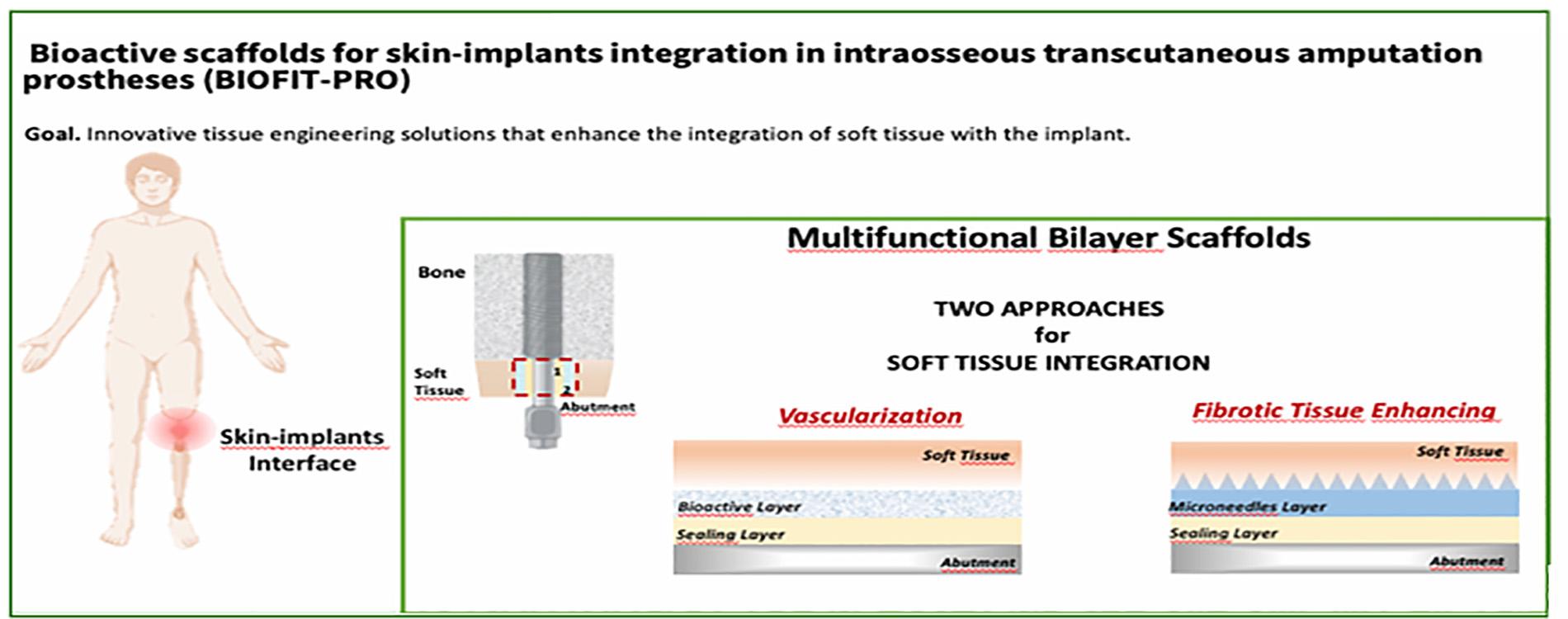
Conventional amputation prostheses rely on a socket attached to the stump, which can lead to soft tissue complications. Intraosseous Transcutaneous Amputation Prostheses (ITAP) offer a more stable solution by directly loading the skeleton, but infections at the abutment-skin interface remain a major challenge. This interface, where the implant penetrates the skin, is vulnerable to microbial invasion, leading to issues like epithelial downgrowth and marsupialization. BIOFIT-PRO project aims to address these challenges by developing a novel bilayer scaffold designed to enhance ITAP integration and prevent infection. The scaffold consists of a sealing layer made from polyvinyl alcohol (PVA), which acts as a barrier to microbial penetration, and a bioactive layer made from porous cryogels (GelMA and PEGDA) that promotes tissue ingrowth. The project focuses on the design, fabrication, and characterization of these hydrogels using 3D bioprinting and other advanced techniques. In vitro testing will evaluate the mechanical, biological, and infection resistance properties of the scaffold. The goal is to create a biocompatible, mechanically stable scaffold that improves ITAP implant integration, reduces infection risks, and addresses long- standing issues at the abutment-skin interface.
Objectives
- Objective 1 - Develop soft tissue integration interfaces for transcutaneous implants in limb prosthetics: Create a versatile, robust interface that improves the integration of transcutaneous devices with the body, focusing initially on transcutaneous lower limb prosthetics.
- Objective 2 - Extend the model to other applications, such as dental implants: Adapt and optimize the soft tissue integration model developed for limb prosthetics to be applicable to dental implants and other implantable devices.
- Objective 2 - Extend the technology to integrate multilayered tissues: Expand the developed integration model to work with multilayered tissues, such as skin, articular cartilage, and other complex tissues, for broader medical and biomedical applications.
Collaborators
- University of Naples “Federico II” (Paolo Netti, Francesco Urciuolo)
- Centro protesi INAIL (Emanuele Gruppioni)
Key 5 publications
- 1. Scalera F, Monteduro AG, Maruccio G, Blasi L, Gervaso F, Mazzotta E, et al. Sustainable chitosan-based electrical responsive scaffolds for tissue engineering applications. Sustain Mater Technol. 2021;28:e00260.
- 2. Crovace AM, Di Giancamillo A, Gervaso F, Mangiavini L, Zani D, Scalera F, et al. Evaluation of in vivo response of three biphasic scaffolds for osteochondral tissue regeneration in a sheep model. Vet Sci. 2019;6(4):90.
- 3. Palazzo B, Scalera F, Soloperto G, Scialla S, Gervaso F. Recent Strategies in Osteochondral Substitutes Design: Towards the Mimicking of a Multifaceted Anatomical Unit from the Nano to the Macro Level. J Nanomed Nanotechnol. 2017;8(2).
- 4. Palazzo B, Scialla S, Barca A, Sercia L, Izzo D, Gervaso F, Scalera F. Towards Complex Tissues Replication: Multilayer Scaffold Integrating Biomimetic Nanohydroxyapatite/Chitosan Composites. Bioengineering. 2024;11(5):471.
- 5. Peretti G, Fraschini G, Sannino A, Gervaso F, Scalera F, Di Giancamillo A, et al. Composite scaffold for tissue repair. US Patent 10,940,236. 2021.
People
- Ilaria Sergio
- Laura Sercia
- Alberto Portone
- Francesca Gervaso
- Alessandro Polini (CNR NANOTEC)
